
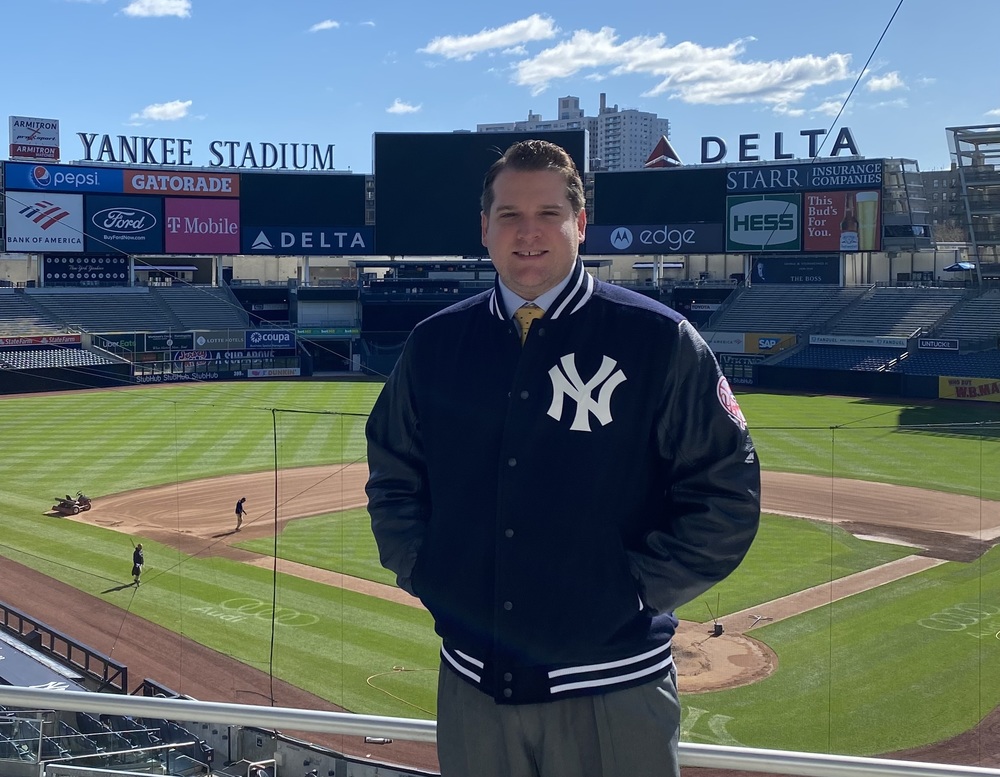
Working for a professional sports team isn’t just fun and games. Michael Parker’s role as Director of Financial Operations for the New York Yankees requires more than just watching baseball and rooting for the home team. The 2002 PCS graduate oversees the budgeting and financial forecasting for 50+ departments – all while working to help the organization achieve its ultimate goal – winning a World Series.
“I truly love working for the Yankees,” said Michael. “My favorite time of year is late summer and early fall. As school starts and the weather begins to cool down, I know it’s time for October baseball in the Bronx.”
It was December 2012 when Michael left his position at PricewaterhouseCoopers (PwC), where he had interned and worked since 2006, and began his tenure with the Yankees. At the start of his career at PwC, Michael worked auditing clients in the entertainment and media industry like Showtime Networks and King World, a company that syndicated shows like Dr. Phil, Oprah, and Jeopardy. He eventually assisted in the revenue sharing audit and postseason audit for Major League Baseball (MLB). His expertise in the revenue sharing system, which distributes revenues from larger market teams to smaller market teams, ultimately led to his position with the Bronx Bombers.
In his role with the Yankees, Michael oversees all of the budgeting and forecasting for the entire organization. This includes predicting how many tickets will be sold and how much revenue will be generated for each MLB game at Yankee Stadium to how much the organization spends on baseballs and bats for their minor league affiliates. All of the 50+ departments have their own operating budget. Beyond the perceived glitz and glamor of professional sports, the front office of the organization is run like any other 9 to 5 business with departments like Human Resources, Information Technology, Accounting, etc. There is, of course, one huge, glaring difference between working for the Yankees compared to any other business – the chase for a championship. Even for a die-hard baseball fan, the job doesn’t come without its pitfalls. At each of the team’s 81 home games, one person from Michael’s department must be present. That means late nights, especially for games that go into extra innings or have weather delays.
“I love the team camaraderie that working for a professional sports team affords,” said Michael. “Every day in the office we talk about the previous night’s game, dissect the on-field results, and predict how the season will go. The baseball season being a marathon 162-game schedule is really a day-to-day game that ebbs and flows throughout the summer. I enjoy the daily interaction that comes with being a baseball fan.”
When Michael graduated from PCS in 2002, he didn’t know what he wanted to do. His strongest subject was math, so he enrolled in Ithaca College’s Business School. After taking classes like marketing, operations, law, and accounting, he decided to concentrate on accounting and finance. He went on to earn a degree in Finance and Accounting, and stayed on at Ithaca to earn his Master of Business Administration. For current PCS students looking to follow a similar path, Michael recommends that they be flexible and patient when thinking about their future career.
“The path from beginning to end is rarely a linear, consistent trajectory. Being open to new opportunities and possibilities is important.”
He’s now giving that same advice to his own students. In 2021, Michael began teaching a course called “Sports Accounting and Finance” at Columbia University, which is part of the Sports Management master’s degree program. He’s found teaching to be a very rewarding experience. Michael’s students often ask him how they can differentiate themselves from others.
“My answer is always the same. Do the work that is assigned to you and do it to the best of your ability,” he said. “That means not just doing your best when your boss or supervisor is watching, but all the time; even when no one is watching. Never give anyone a reason to say ‘no’ when your name comes up for a new opportunity or promotion.”